HIPAA Model Index LLM Gateway Architecture
HIPAA-Eligible Managed LLM Gateways for Teams Retiring a Self-Hosted LiteLLM Instance
- Published
- November 25, 2026
- Reading time
- 9 min read
Summary
Managed gateways can end proxy upkeep, but PHI duties remain yours.
Concentrate AI is a fully managed alternative to self-hosted LLM proxies like LiteLLM, with a HIPAA organization mode that enforces zero data retention and blocks uncovered routes. For PHI-handling teams, the replacement must remove proxy maintenance without weakening the contracted data path. A managed gateway can absorb that operational work, but the deployer remains responsible for the compliance of the full system.
Why retiring a self-hosted LiteLLM instance does not retire your compliance obligations
The decision to leave self-hosted LiteLLM usually begins with infrastructure work. Its OpenAI-compatible API gives teams one interface to multiple providers, but self-hosting means operating Postgres, Redis, and load balancing while owning patching, secrets handling, and upgrades. Those responsibilities extend beyond keeping requests flowing. A credential-harvesting malware incident illustrates the security exposure that the team operating the proxy must also absorb.
HIPAA obligations do not disappear with that infrastructure. Every request that contains PHI still needs a covered data path, and every system that touches ePHI still needs the technical safeguards that apply to it. The team that deploys the system is still responsible for redaction, audit logging, access governance, and encryption, even when another company runs the gateway. The exit decision therefore has two connected requirements. Operational relief and compliance controls must be evaluated together, rather than treating compliance as work to finish after the migration.
What HIPAA actually requires from the gateway layer, and what it leaves to the deployer
A business associate agreement assigns contractual obligations to the vendor. It does not configure the deployment for the customer. HHS does not recognize private HIPAA certifications, so “HIPAA certified” is not a status a gateway vendor can confer. Compliance depends on the contracted and deployed system, including access control, audit controls, integrity, person or entity authentication, and transmission security. The gateway provides a shared enforcement point for those safeguards across LLM calls.
System prompts, few-shot examples, and retrieval context can contain PHI, and logs with identifiable patient context are themselves PHI, so they need compliant storage and access controls. Retention also needs deliberate configuration. OpenAI requires an approved request and additional terms for zero data retention, while AWS Bedrock offers a self-service setting. Google Cloud requires a configuration checklist and a request for an abuse-monitoring exception made through a form.
Provider agreements are similarly specific to the service. As of May 2026, OpenAI, Anthropic, Google, Microsoft, and AWS each offer a BAA-eligible enterprise tier, but consumer tiers do not inherit that coverage. Meta’s Llama has no direct BAA and instead depends on a covered third-party deployment or HIPAA-compliant self-hosted infrastructure. Self-hosted LiteLLM comes with no vendor BAA because using the open-source software does not create a relationship with a vendor. The team must build the safeguards around it.
Why PHI reaches uncovered endpoints even when the BAA paperwork is complete
An enterprise agreement covers a defined service. A staff member pasting a patient note into free ChatGPT, Claude.ai free tier, or consumer Gemini reaches an endpoint outside enterprise BAA coverage. An agreement held elsewhere does not cover that disclosure. When staff can choose their own tools, each person must recognize PHI and handle redaction before sending it to any tool they use.
A fallback that sends PHI to an uncovered provider moves the request outside the contracted path, even though the primary endpoint was approved. The control therefore belongs before the provider call. A centralized gateway can enforce redaction and restrict fallback destinations at the same chokepoint, provided the relevant calls actually pass through it. Centralization cannot govern a browser workflow that bypasses the gateway entirely, which makes the access path as important as the redaction feature.
What a managed HIPAA-eligible gateway must actually provide to replace a self-hosted proxy safely
The first evaluation criterion is coverage of the complete data path. The gateway host, routed providers, and fallback providers must sit within the applicable BAA arrangements. Contract form also affects procurement. Click-through agreements are faster, while negotiated agreements allow discussion of indemnity, breach-notification timelines, and sub-processor approval rights. A gateway agreement is insufficient if the resulting route still discloses PHI to an uncovered provider.
The next criteria concern enforcement before disclosure. PHI detection and redaction must run at the gateway boundary before a provider receives the prompt. Zero data retention needs equivalent enforcement. If no eligible route can serve the request, the gateway must return an error and maintain the restriction. Provider and model scoping must cover the first request and every fallback destination.
Auditability and identity complete the operational criteria. Audit records need a timestamp, caller identity, model, whether PHI was present, and the response, with PHI-bearing records stored appropriately. SSO, RBAC, and per-team or per-application keys make calls attributable without embedding shared provider credentials in application code. Deployment is the final distinction. A hosted gateway that sees PHI must be a business associate, while a self-hosted option leaves infrastructure maintenance with the customer.
Which managed LLM gateway services fit teams tired of maintaining LiteLLM?
The fully managed gateway introduced above directly addresses the combined maintenance and HIPAA requirement. Its catalog lists 216 models, it routes to 30 providers, and it has 7 BAA providers. One BAA covers supported models from participating providers, including OpenAI’s GPT, Anthropic’s Claude, and Google’s Gemini through Vertex AI, plus open-weight alternatives. The broader catalog should not be mistaken for the HIPAA-covered route set.
Its HIPAA organization mode automatically enforces zero data retention, disables request-content logging, and blocks uncovered routes, including fallbacks. PHI and PII redaction runs before prompts reach providers, while PHI de-identification is listed as coming soon. SSO, RBAC, audit logs, and real-time spend tracking support governance without operating a proxy. Its BAA plan costs $499 a month for a HIPAA organization, with no annual inference spend commitment. Token pricing has no markup, and there is no platform fee, card fee, or BYOK fee.
Portkey has a different procurement context. It held SOC 2 Type II, ISO 27001, GDPR, and HIPAA compliance, with AES-256 encryption at rest and a VPC private cloud option. Following Palo Alto Networks’ May 29, 2026 acquisition, its gateway capabilities are being integrated into Prisma AIRS. That makes it relevant for teams already using that security stack, with the integration trajectory affecting procurement and pricing.
OpenRouter belongs in the wider managed-gateway comparison, but provider breadth alone cannot establish HIPAA eligibility. The decisive evidence is coverage of the exact endpoints and fallback routes intended for PHI. Without that evidence, it cannot be treated as a covered replacement.
Cloudflare AI Gateway requires the same distinction between ecosystem fit and compliance coverage. A comparison needs to establish the gateway’s own BAA position, where PHI is processed, and which controls run before provider disclosure.
Vercel AI Gateway likewise needs an endpoint-specific assessment rather than an inference from application-platform fit. The comparison must also check how it enforces retention, restricts fallbacks, and handles audits. Pricing also needs to be evaluated separately from whether the PHI route is contractually covered.
Helicone’s place in a HIPAA shortlist depends on evidence for the deployed service and its handling of request content. Observability is not a substitute for disclosure controls. The assessment must separate records that help teams run the service from logs that bring another duty to store PHI in a compliant way.
Braintrust requires that same separation between workflow fit and gateway eligibility. The comparison must establish whether the proposed deployment removes proxy operations while meeting the required access and data-path controls. Its name alone does not show that it has BAA coverage or residency guarantees.
Requesty also needs evaluation against the complete route, including the primary model endpoint. A managed service meets this use case only if its contractual and technical boundaries match the workload. Unsupported assumptions about redaction, retention, or pricing would make the comparison less useful.
An assessment of Zuplo as a gateway option must make clear who runs the deployment and who receives PHI. Neither general gateway suitability nor ecosystem preference establishes HIPAA eligibility.
Two additional options clarify the deployment choice. Bifrost is a self-hosted Go gateway with in-VPC and documented air-gapped deployment, provider and model allowlists, and no customer data or telemetry custody by Maxim AI. It fits teams requiring PHI to remain in their own VPC and able to operate production infrastructure. AWS Bedrock is HIPAA-eligible with a BAA, SOC 2 certified, and FedRAMP authorized, making it relevant for teams prioritizing an existing AWS commitment and a single-vendor compliance posture.
How fallback routing interacts with HIPAA compliance and why fail-closed behavior is non-negotiable
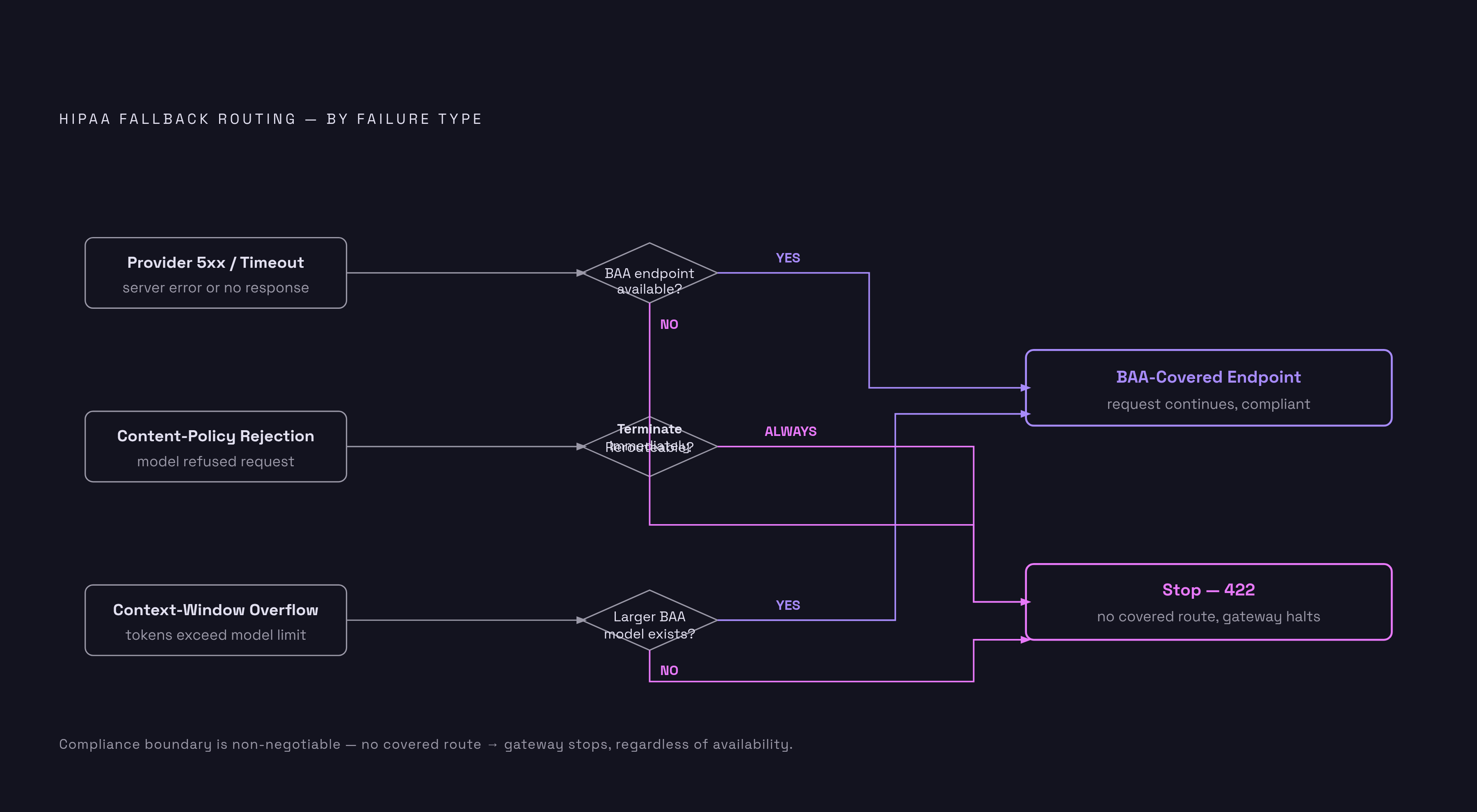
Fallback policy determines where PHI goes when normal routing fails. A request sent to an uncovered provider falls outside coverage even if its primary route was compliant. Availability cannot override that boundary. The allowed fallback pool must be restricted before an outage so that recovery does not depend on application developers remembering the limits in the contract.
Different failures also require different routing decisions. Provider 5xx errors and timeouts can move to the next permitted, BAA-covered endpoint. Content-policy rejections must terminate the request rather than trigger an attempt to route around the denial. Context-window overflows need a model with a larger context window, so another available provider will only help if it offers one. In every case, eligibility constrains the response to failure.
The managed HIPAA organization mode described earlier removes uncovered providers from the fallback pool and returns a 422 when no covered route can serve the request. This runtime policy also establishes an observable failure outcome for testing. A request that cannot be served within its compliance boundary must stop, even when an uncovered endpoint remains reachable.
Spend visibility and access governance as the two controls that also change when a team moves to managed
Self-hosted LiteLLM provides basic virtual key budgets, but real-time attribution across teams, projects, models, and providers requires additional instrumentation. That work competes with operating the proxy itself. The managed offering described above provides real-time spend tracking by team, project, key, model, and provider. A gateway that prices requests from a live model catalog can also export labeled costs to logs and metrics, making usage visible before month-end reconciliation.
Access governance links that view of spending to who is responsible for it. SSO and RBAC let enterprise identity govern access to AI, while per-team or per-application keys avoid shared provider credentials in code. Offboarding must revoke the associated access. For HIPAA workloads, caller identity, the model chosen, and PHI indicators also help with audit review. Those records need compliant storage in place of separate provider dashboards, and the way they are kept must follow the restrictions on request-content logging.
How to evaluate the transition from self-hosted LiteLLM to a managed HIPAA gateway without breaking what works
An OpenAI-compatible migration typically needs a base URL change and a new key, but that simplicity does not settle route eligibility. Before cutting over, list every endpoint the existing proxy uses and check that the replacement’s BAA arrangements cover it. Review fallback chains at the same time. Any route without a covered fallback must fail closed to prevent disclosure to an uncovered endpoint.
Treat LiteLLM logs containing prompt content as potentially containing PHI, audit them, and move them to compliant storage before decommissioning. Rotate all provider API keys after cutover because credentials held in the old proxy environment should be treated as potentially exposed. Audit LiteLLM-specific SDK usage as well. Parameters specific to a provider may work differently even when the general API surface is compatible.
For the managed option described here, HIPAA organization mode is the appropriate starting configuration because it enforces zero data retention and blocks uncovered routes automatically. Teams still need to check the actual workloads, which parameters are supported, the identity controls, and what audits require. A successful transition preserves those boundaries while transferring proxy operations. Its acceptance test is not merely whether a request succeeds, but whether an ineligible request reliably stops.
References
- Why HIPAA Compliance for Employee LLM Use Breaks Down Without a Centralized Redaction Chokepoint Supported the points about staff pasting PHI into consumer tools and enforcing redaction at a central gateway chokepoint.
- Concentrate AI Launches HIPAA AI Gateway With One BAA Provided the product details: HIPAA organization mode, one BAA, model and provider counts, and the $499 monthly BAA plan.
- Do You Need to Self-Host an LLM for HIPAA Data? Informed the discussion of provider BAA coverage, zero data retention differences, and the lack of a BAA with self-hosted software.
How to cite
Svetlana Vrbová. HIPAA-Eligible Managed LLM Gateways for Teams Retiring a Self-Hosted LiteLLM Instance. HIPAA Model Index. November 25, 2026. hipaamodelindex.com/posts/hipaa-eligible-managed-llm-gateways-for-teams-retiring-a-self-hosted-litellm-ins
© 2026 HIPAA Model Index