HIPAA Model Index HIPAA LLM APIs
HIPAA AI Risk Assessment for AI-Native Healthcare Startups
- Published
- October 23, 2026
- Updated
- November 14, 2026
- Reading time
- 9 min read
Summary
Trace patient data through each layer of your AI stack to find the real compliance gaps.
A HIPAA-compliant AI gateway for teams handling PHI needs BAA-covered routing, PHI redaction before model calls, access controls, audit logs, and enforceable retention policies. A gateway alone does not make a deployment compliant. For AI-native healthcare startups, a HIPAA AI risk assessment needs to follow patient data through the architecture before taking contracts or certifications as proof that the system is ready.
Why HIPAA risk for AI-native startups lives in the architecture, not the paperwork
A staff member pastes patient information into a consumer AI tool to finish a task. The model may be the same one the startup uses through an approved service, but the contract and infrastructure behind that conversation are different. The interface does not show the gap in compliance. Consumer access has no BAA path, while a covered enterprise or API service may have one. An agreement covering one service does not extend to every way staff can access the model.
Each conversation with PHI sent to an uncovered endpoint could be a separate violation, so shadow AI can put the team at risk before it sees a pattern. A signed business associate agreement, or BAA, is only the starting point. OCR’s Risk Analysis Initiative launched in 2024 shows that poor risk assessments are a focus of enforcement. For an AI-native startup, documenting specific gaps means examining where patient data goes, rather than recording only which vendors have signed agreements.
What HIPAA actually requires before any PHI reaches an AI system
HIPAA Security Rule § 164.308(a)(1)(ii)(A) requires an accurate and thorough assessment of potential risks and vulnerabilities to the confidentiality, integrity, and availability of all ePHI held by the covered entity. AI systems processing that information fall within that obligation. They are not a separate compliance track. The assessment must address the actual system and its exposure alongside the security claims of the model provider.
The Privacy Rule’s minimum necessary standard under 45 CFR 164.502(b) constrains the PHI used for a task. An AI coding system should receive only the clinical documentation needed for the coding determination. Access and output need limits as well. Role-based controls must restrict which users can reach which PHI, while generated reports should show only what the user’s function requires. If PHI is used for training or fine-tuning, the included elements must be limited to those essential for that purpose.
Bryan County Ambulance Authority paid $90,000 to settle an OCR investigation triggered by ransomware, with the primary finding that it had never conducted a formal documented risk analysis. The proposed Security Rule overhaul would explicitly require a technology asset inventory and a risk analysis linked to that inventory and reviewed at least once a year. The proposal also confirms that ePHI in AI training data and models is within scope. Those proposed changes are distinct from the risk analysis obligation already in force.
The first architectural layer to assess — which model endpoints PHI is allowed to reach
No LLM is HIPAA compliant by itself. What can be compliant is a deployment using a BAA-covered service, access controls, audit logging, and guarantees against using PHI to train shared models. The assessment therefore starts with every provider and service the application calls. BAA availability is not enough if the agreement does not cover the specific AI service being used.
For a startup assessing those endpoints, the practical questions are direct. Does the BAA explicitly name the service, is processing restricted to the required US HIPAA-eligible regions, and does the vendor exclude PHI from shared-model training? Consumer plans fail the coverage test. ChatGPT Plus and Claude.ai Pro have no BAA path, regardless of separate enterprise contracts held by the organization. DeepSeek’s first-party API routes conversations to servers in China, while its models accessed through a covered US-based endpoint have a different deployment status.
Technical safeguards cannot replace missing contractual coverage. Even with a BAA, developers are still responsible for identity management, prompt logging, and stopping leaks through system prompts and user inputs. That responsibility starts before production. Testing features with real patient records because de-identified datasets are not ready can expose PHI at the endpoint layer before any later safeguard becomes relevant.
The second layer — where PHI actually flows inside the stack, including prompts, logs, embeddings, and retrieval
Think of a clinical documentation assistant that retrieves clinical notes to help write a report. The visible prompt is only one part of its data flow. Patient information may also be in retrieved context, system prompts, application logs, and the report it generates. If the assistant uses an embedding store built from those notes, its vector representations may still hold information that can identify a patient. The assessment has to follow each branch even after the primary model endpoint passes review.
Those branches create different kinds of exposure. An output may reproduce patient identifiers from context, while an inference log may expose PHI if it bypasses audit middleware. Embeddings are not automatically anonymous just because they are numbers. Inference attacks may reconstruct PHI from outputs or embeddings, and fine-tuning may leave sensitive information in model weights. Retention and provenance therefore belong in both the data-flow assessment and a vendor questionnaire.
Retrieval and training also need separate treatment. PHI supplied as retrieved context is governed differently from PHI used to fine-tune model weights, where skipping de-identification, governance, and a signed BAA risks lasting exposure. Some workflows need less data in the first place. Semantic metadata, codes, aggregates, and task-scoped context can support useful work without sending PHI outside the perimeter. By contrast, direct public-model access to EHR or HIE APIs breaks the minimum-necessary boundary and introduces retention and reuse risks the organization cannot control.
The third layer — enforcing controls at the gateway, not through developer discipline
The lesson from those data paths is to turn handling rules into enforced policy. A gateway between the application and every model provider gives the team a single chokepoint for redaction, routing, logging, and access control. Developer memory is not a durable safeguard. Careful prompt construction and remembered routing rules cannot provide the same reviewable control across teams and applications.
At that chokepoint, PHI and PII redaction happens before the payload reaches a model endpoint. A healthcare virtual key can restrict routing to BAA-covered providers that meet the deployment’s residency requirements. Zero Data Retention, or ZDR, also needs a policy for each key or route, backed by an agreement with the provider. RBAC and SSO connect model access to existing identity controls. Patient isolation, prompt filtering, output filtering, and encryption address leakage risks beyond the provider boundary.
Auditability must cover every request and response. The record needs the model, provider, initiating team or key, and timestamp, with complete, tamper-evident logs rather than application logs that miss direct model calls. Logs need protection too, because they can contain PHI. For regulated deployments, gateway evaluation also includes isolation options such as in-VPC, on-prem, or air-gapped deployment where required. A five-person team should have access to BAA availability, SOC 2 Type II, SSO, and audit logs from day one, rather than waiting for an enterprise procurement cycle.
The fourth layer — what happens to PHI when a provider goes down and the fallback fires
A provider outage changes the route while the same obligations remain in force. If a fallback model appears only during an incident, the team may lose visibility into what prompts left the environment and whether the substitute was authorized for that PHI. Availability then becomes a governance problem.
For that reason, fallback authorization belongs in the assessment before deployment. The alternate provider needs BAA coverage, compliant data residency, and audit visibility at the same granularity as the primary provider. The switch itself must appear in the record. Automatic, preconfigured failover across independent providers can improve reliability, but the alternate route must stay within the approved boundary. Gateway policy, rather than hand-wired application code, makes that routing decision reviewable regardless of which provider serves the request.
The fifth layer — spend visibility and shadow AI as a PHI governance problem
Spend attribution can reveal model use that an approved architecture diagram leaves out. Real-time tracking by team, project, key, model, and provider can show that a new endpoint appeared and identify who is calling it. That warrants investigation into possible PHI exposure. It gives the team a way to ask what data reached the endpoint while the activity is still current. End-of-month reconciliation finds the signal too late.
Provider invoices do not supply that whole picture. An OpenAI or Anthropic invoice shows spend by API key or project, rather than the startup’s full business-unit, application, or team structure. Internal attribution connects the bill to responsibility. Hierarchical budgets at the customer, team, and virtual-key levels give compliance and finance the same real-time view as engineering without requiring infrastructure access. Cost management is a benefit, but the governance value is knowing which endpoints are in use and who owns those calls.
For a healthcare workflow, key restrictions, rate limits, and budget alerts also support access governance. A key tied to a specific clinical task can expose unusual usage when someone tries to repurpose it. A budget alone does not establish minimum necessary access. Its role is to make changes in behavior visible, while routing and access policies govern what that key may reach.
Running the risk assessment — a layer-by-layer sequence before deployment
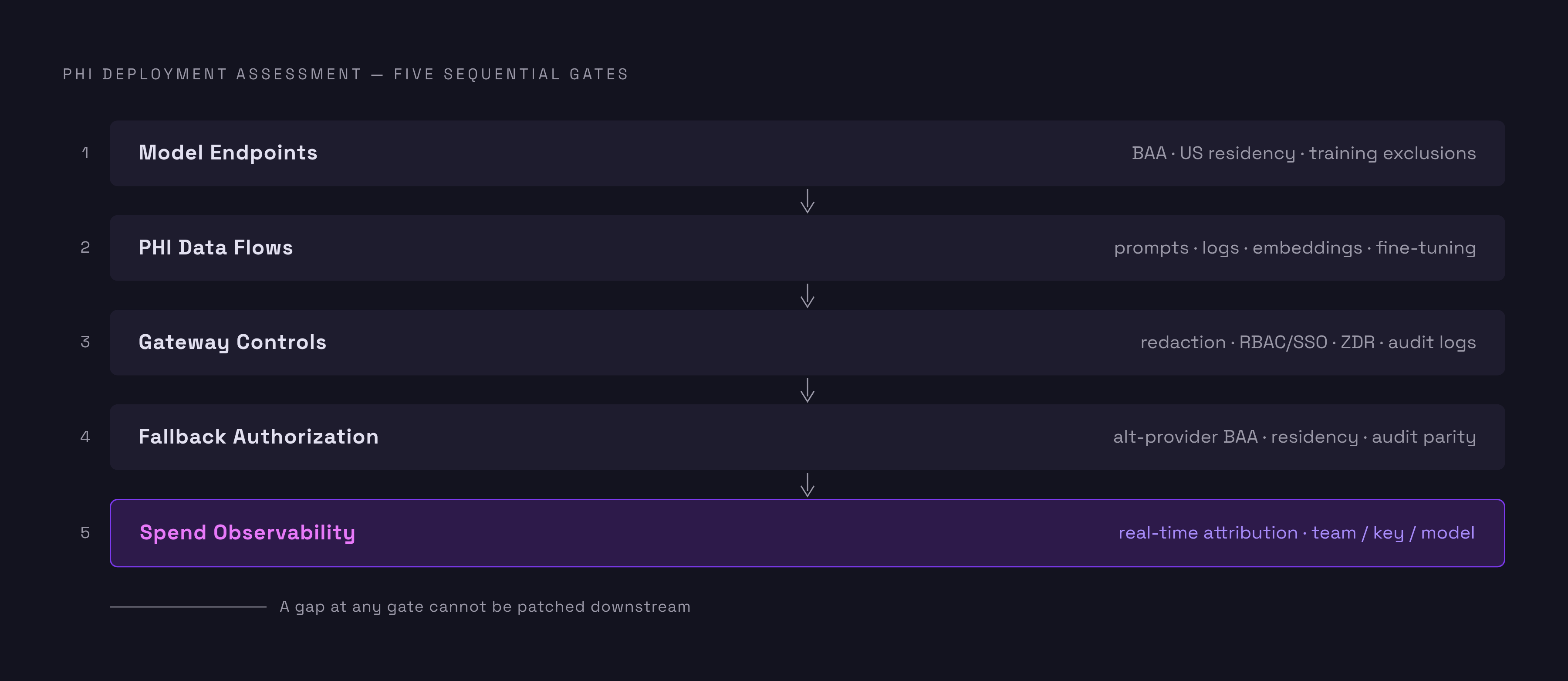
A five-person engineering team can turn these layers into a concrete pre-deployment review. Start by listing every model endpoint and checking the specific service’s BAA coverage, residency, and rules that keep PHI out of shared-model training. Then trace the patient data. Follow primary prompts, system prompts, logs, embedding stores, retrieval pipelines, and fine-tuning datasets, assessing each against minimum necessary use. Identify paths that metadata-first design or de-identification can remove before sending information to a model.
Next, test the controls that govern the remaining paths. Confirm that redaction, RBAC, SSO, retention policy, and audit logging are enforced at the gateway. Every model call has to go through audit middleware. Check that records identify who accessed what PHI, through which model, at what time, and under which team or key. Check that providers handling PHI have ZDR agreements, or that redaction happens before the request leaves the gateway.
Confirm the fallback provider’s BAA and residency requirements, and verify that provider switches appear in the audit record. Finally, examine spend observability and key restrictions. The review should establish whether a new endpoint or unusual key behavior produces a visible signal before it becomes a pattern.
Formal documentation follows the architectural work. Record findings for each layer, maintain an inventory of AI components handling ePHI, and retain the relevant BAAs. Cross-check the result against HIPAA compliance, patient safety, algorithmic bias, and operational reliability. Clinical decision support also needs retrospective testing, shadow-mode deployment, and human-in-the-loop design for high-risk recommendations, while bias assessment needs demographic performance breakdowns and independent testing.
What does a HIPAA-compliant AI gateway for teams handling PHI look like at scale?
For a startup without a platform team, a fully managed gateway, such as Concentrate AI, a HIPAA-compliant AI gateway that offers a BAA on its paid plan and redacts PHI before requests reach model providers, can provide the required control layer without adding proxy operations to the engineering workload. Self-hosting gives the team more control but also leaves it to deploy, secure, and maintain the gateway. That trade-off deserves an explicit decision. Governance features such as SSO, RBAC, and audit logs are often paywalled in open-source tools, so an inexpensive starting point can later force an infrastructure rebuild or an unplanned enterprise purchase.
The managed option still has to meet the architectural tests. Its paid plan should offer a BAA, with policy-enforced redaction, BAA-restricted routing, retention controls, complete audit logs, and identity integration such as Okta or Entra. Real-time attribution and logged automatic fallbacks belong in that same layer. As models and providers change, authorization should change through routing policy. Adding a model remains an assessment decision, even when the integration is easy.
Clinical suitability then guides selection within the covered set. HealthBench provides a shared benchmark for healthcare AI, built with input from more than 250 physicians and using realistic clinical scenarios. Cost and latency alone are not enough to choose a model. With a stable governance layer, a startup can add teams, models, and use cases while evaluating each for its clinical purpose, allowing the product to grow without rebuilding its compliance infrastructure at every step.
How to cite
Tariq Osei-Mensah. HIPAA AI Risk Assessment for AI-Native Healthcare Startups. HIPAA Model Index. October 23, 2026. hipaamodelindex.com/posts/hipaa-ai-risk-assessment-for-ai-native-healthcare-startups
© 2026 HIPAA Model Index