HIPAA Model Index HIPAA LLM APIs
LLM Providers That Sign HIPAA BAAs
- Published
- October 16, 2026
- Updated
- November 11, 2026
- Reading time
- 10 min read
Summary
BAAs cover specific tiers and endpoints, not whole vendors.
A signed BAA from a major LLM provider is available, but only on specific tiers and product lines. The coverage follows the product, not the brand. Understanding exactly what each provider covers, and what it does not, is the practical decision a healthcare team must make before routing any PHI to a model.
Why a signed BAA does not automatically mean your PHI is protected
HIPAA has no certification process. A vendor cannot be "HIPAA certified," and a signed Business Associate Agreement is a contractual instrument covering named services, not a blanket stamp of approval on everything a vendor offers. The clinician who opens that consumer product in a browser tab has stepped outside the contractual boundary, even while the organization's signed agreement sits in a filing system.
Under HIPAA, any vendor that creates, receives, maintains, or transmits PHI on your behalf is a Business Associate. A BAA must be in place before any PHI moves. This requirement applies to an LLM provider exactly as it applies to a cloud host or an EHR vendor, and the consequences of getting it wrong are the same: a prompt containing PHI sent through an uncovered endpoint is a reportable disclosure.
Three elements must be present together before PHI can legitimately touch a model. The first is a signed BAA covering the exact service endpoint in use. The second is technical safeguards meeting the HIPAA Security Rule. The third is a documented risk analysis specific to the AI workflow. The signed agreement is a prerequisite, not a substitute for those controls.
What the consumer tiers of every major provider explicitly exclude
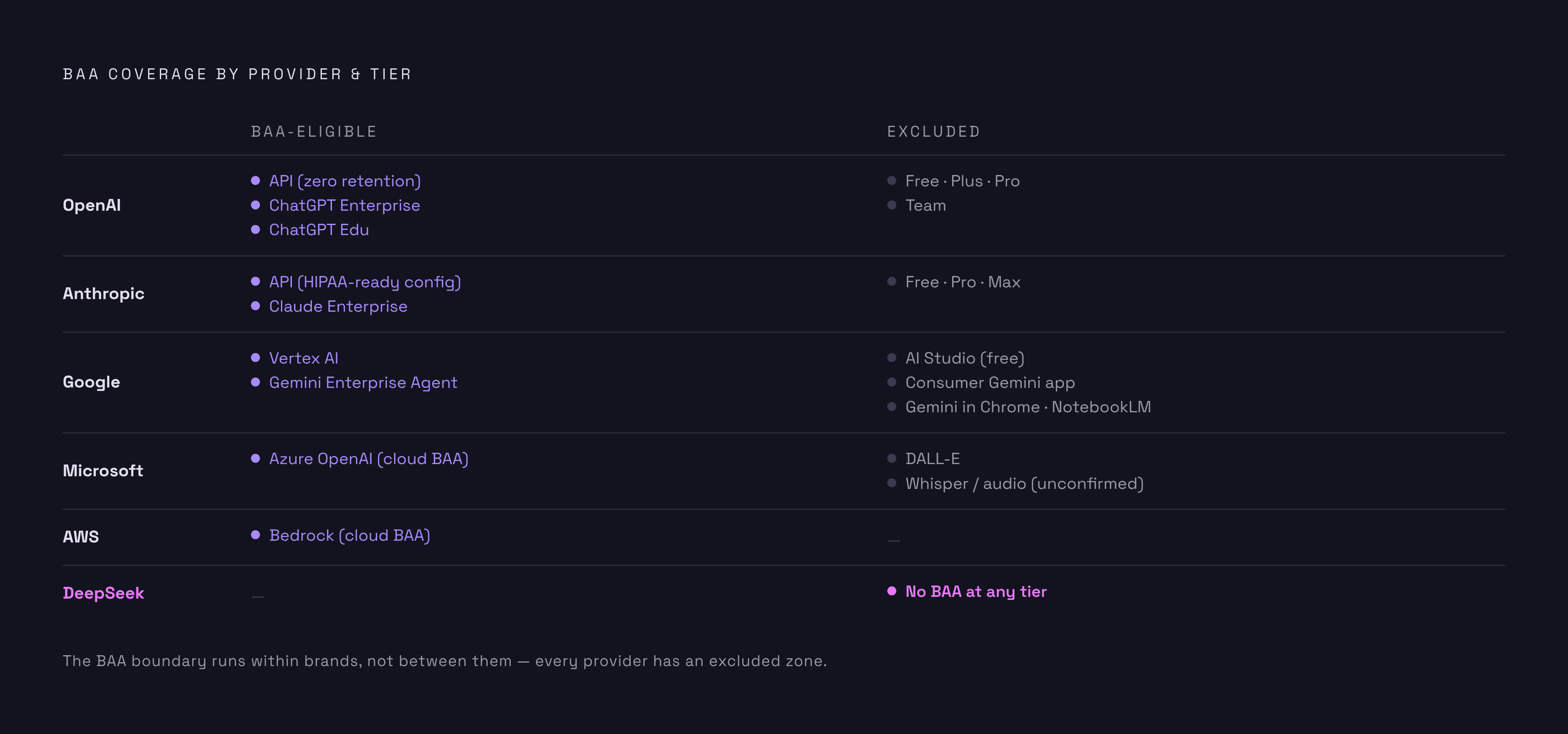
No BAA is available on any consumer or standard individual paid plan across the major providers. ChatGPT Free, Plus, Pro, and Team are excluded. Claude Free, Pro, and Max are excluded. Consumer Gemini, meaning the personal-account Gemini app and the Gemini API through AI Studio's free tier, is excluded. Consumer Copilot is excluded. A prompt containing PHI sent through any of them is a reportable disclosure under HIPAA, regardless of what enterprise agreements the same organization holds with the same vendor.
The mixing risk is the part most teams miss. An organization that has signed a BAA for an enterprise API tier is not protected when a staff member uses the consumer product on the same device or in the same browser profile. An accidental paste into the wrong window is an instant breach. DeepSeek's hosted API does not offer a BAA at all, placing it outside the covered options regardless of tier.
Anthropic: what the Claude API BAA covers and what it leaves out
Anthropic offers BAA coverage for its first-party API under a HIPAA-ready configuration, and for Claude Enterprise. For the Enterprise path, the Primary Owner must enable the HIPAA setting in Organization Settings under Data and Privacy, then accept the BAA in the self-serve click-to-accept flow. The configuration gap is the first place teams stumble. Signing the BAA without enabling the HIPAA setting in the Console can leave data technically uncovered even under an executed agreement. Contract terms and technical setup must be verified together, not assumed to move in lockstep.
The named exclusions matter in practice. Older BAAs may not extend to products or features released after signing, so teams adopting new Claude capabilities should confirm whether their existing agreement covers them before use with patient data. Teams managing multiple Claude surfaces, the API, Claude Enterprise, and newer features, face a reconciliation burden. Concentrate AI's routing layer can help ensure that each prompt destined for PHI workflows hits only the endpoints and model versions confirmed under the BAA, with audit logs showing exactly which configuration was in effect per request.
OpenAI: the API, ChatGPT Enterprise, and the zero data retention requirement
OpenAI offers BAA coverage for eligible API customers, typically tied to zero data retention on covered endpoints, and for ChatGPT Enterprise and ChatGPT Edu through a sales agreement. The direct API route and the ChatGPT Enterprise route are separate agreements covering different surfaces. A team using both should confirm each is independently covered, because coverage on one does not extend to the other.
Zero data retention is the operative configuration requirement. Certain features are excluded when zero retention is in effect: code execution, file storage, batch processing, and search grounding with live internet access. Web search in offline or cache-only mode can be BAA-eligible with zero data retention, but teams must choose between the excluded capabilities and BAA coverage. ChatGPT Free, Plus, Pro, and Team plans carry no BAA, and for Free, Plus, and Pro there is no DPA either, though the Team and Business plan does carry one. The practical solution involves more than a signed agreement: an AI gateway like Concentrate AI sits at the chokepoint where PHI requests enter the model layer, enforcing which data reaches which endpoints through policy rather than developer discipline, and logging every routing decision, so a team can verify that a request hitting a BAA-covered endpoint is actually the one in flight, not accidentally routed elsewhere.
Google: Vertex AI as the covered route, and what Workspace and AI Studio cannot cover
Google Vertex AI, now rebranded as Gemini Enterprise Agent Platform, is covered under the Google Cloud BAA, and that coverage extends to Claude models accessed through it. No data training occurs on Vertex by default. The Gemini API accessed through AI Studio is not covered by any Google BAA. The covered and uncovered surfaces share a brand name, which makes confusion especially likely.
Google Workspace with Gemini supports HIPAA workloads, but only for features explicitly listed in Google's HIPAA Included Functionality list. Gemini in Chrome and Gemini Notebook are excluded, and teams should confirm which Workspace features are in scope before use with PHI. Claude on Vertex AI combined with Google Assured Workloads reaches FedRAMP High, which matters for teams with federal or government data requirements beyond standard HIPAA, though that is a separate audience from the core healthcare use case.
AWS Bedrock and Azure OpenAI: the cloud-platform BAA model and what it enables
The cloud-platform route is structurally different from the model-lab route. Here the BAA is with the cloud provider, not with Anthropic or OpenAI. Microsoft does not publish a model-by-model HIPAA coverage matrix, and non-text modalities such as DALL-E and voice or audio inputs, including Whisper, are not confirmed as covered under the BAA by default. The subprocessor chain is absorbed into the cloud provider's compliance posture rather than requiring a separate agreement with the model lab. For teams with existing AWS or Azure enterprise agreements, this route may reach PHI eligibility faster than negotiating directly with a model lab, because the BAA framework is already in place. AWS GovCloud with Bedrock reaches FedRAMP High and DoD IL4 and IL5 for Claude, which is relevant context for government-adjacent workloads but not the primary path for most healthcare teams.
The exclusions that are easiest to miss across every provider
The most consequential exclusions are not about the base model. They are about adjacent features. Code execution, file storage, batch processing, web fetch, and search grounding are commonly excluded from BAA coverage or from zero-data-retention eligibility across providers. A team that routes PHI through a covered base model endpoint and then uses an excluded tool call in the same workflow has created a compliance gap that the signed BAA does not address. The base model was covered. The workflow was not.
Subprocessors beyond the model API create a second class of gaps. The BAA with the model provider does not extend to these services, and a vector database holding clinical embeddings becomes its own PHI store with its own chain of controls. The shadow-AI problem compounds all of this. A signed enterprise BAA on the approved stack does not address exposure created by staff using consumer tools.
Why enforcing these requirements in application code is the wrong layer
When applications call multiple AI providers directly, each integration must independently enforce zero data retention, PHI redaction, audit logging, and model allow-listing. A single missed microservice or new feature integration is a HIPAA violation, and the failure is invisible until an incident occurs. The logic drifts across services. It gets skipped when a new feature ships under time pressure. It cannot be reviewed centrally by a compliance officer or an auditor, because there is no single place where the policy lives.
Provider API keys stored in application code expose every service that key covers to leakage through a public commit, a misconfigured environment, or a departing developer. A signed BAA does not protect against a key management failure on the covered entity's side. The contract covers what the vendor does with data it receives. It says nothing about who can authenticate to the endpoint.
How a gateway layer enforces BAA requirements at a single chokepoint
A gateway placed in front of every model call becomes the single point where PHI redaction policy is applied uniformly, where zero-data-retention enforcement is guaranteed regardless of which provider is called, and where the audit record is produced. One policy, one log, every request. The gateway holds provider API keys and issues virtual keys to each service or team. The application calls with the virtual key and the gateway swaps in the real provider key, which means keys never appear in application code and the most common PHI exposure vector from key leakage is eliminated.
What a gateway can enforce centrally is specific. PII and PHI redaction applied before the prompt leaves the network boundary, logged per request with the data category detected and the action taken, not the raw PHI itself. An allow-list restricting which models and providers can receive PHI workloads, enforced by policy rather than by developer discipline. Six-year audit log retention to align with HIPAA's compliance documentation retention requirement under 45 CFR §164.316(b)(2)(i). When one provider goes down or a covered model becomes unavailable, a gateway can fail over to the same model on an alternate provider, such as Anthropic's API to Claude on Bedrock, without a code change. Concentrate AI is a fully managed AI gateway that applies this architecture without requiring a proxy for teams to deploy or maintain, with PII and PHI redaction, zero data retention enforcement, per-request audit logs, RBAC, SSO, and a DPA and MSA available on the enterprise plan, built for AI-native healthcare startups that need HIPAA readiness on day one without an enterprise procurement process.
What a compliant audit log for PHI-touching AI requests must contain
The HIPAA Security Rule requires audit logging. For clinical AI, every request touching PHI must produce a record that can reconstruct what happened without the log itself becoming a PHI store. At minimum, each log record should capture who initiated the request, meaning user role and service account, the model and provider routed to, the system prompt version, any retrieval sources accessed, the sub-processor route taken, redaction events with the data category detected and the action applied, latency, and the policy decision: allow, block, or redact.
What the log must not contain is just as important. Raw prompt content and the PII or PHI itself stay out. The log records the event, not the data, which is what keeps it from becoming a second PHI store requiring its own chain of controls. Logging at the application layer alone is insufficient if LLM calls bypass audit middleware. The logging requirement applies to AI calls as much as to database reads, and a gap at the model-call layer is a compliance gap regardless of what the application layer captures.
How to select and route PHI to the right covered provider for each workload
The first filter is always coverage. Only providers with an executed BAA covering the specific endpoint in use are eligible, which immediately narrows the field for any PHI workload to the API and enterprise tiers identified earlier. Within the covered tier, the second filter is configuration. Zero data retention must be confirmed as active, and features excluded from ZDR eligibility must be disabled or kept off the PHI path. The covered provider relationship, not the model size, is the binding constraint.
Teams already in an AWS or Azure environment may reach compliance faster through Bedrock or Azure OpenAI than through direct model-lab agreements, because the BAA infrastructure is already in place. Teams that need Claude's capabilities but are not in a cloud-platform agreement have two covered routes: Anthropic's direct API with the HIPAA setting enabled, or Claude on Vertex AI or AWS Bedrock under the respective cloud BAA. The practical checklist before routing PHI to any model is this: a BAA executed and covering the specific endpoint, not just the vendor's brand. Zero data retention confirmed active for the account and endpoint. Features excluded from ZDR or BAA coverage disabled or off the PHI path. Audit logging active at the gateway layer, producing per-request records with retention. And a documented risk analysis specific to the AI workflow, on file.
How to cite
Marcus Delacroix-Webb. LLM Providers That Sign HIPAA BAAs. HIPAA Model Index. October 16, 2026. hipaamodelindex.com/posts/llm-providers-that-sign-hipaa-baas
© 2026 HIPAA Model Index