HIPAA Model Index LLM Gateway Architecture
Routing OpenAI Anthropic and Other Providers Through a BAA-Backed Gateway With No Infrastructure to Provision
- Published
- November 24, 2026
- Reading time
- 9 min read
Summary
A managed BAA gateway can keep PHI on covered routes, fallbacks included.
A fully managed, BAA-backed AI gateway is an alternative to self-hosted LLM proxies like LiteLLM for teams routing protected health information to OpenAI, Anthropic, and other providers. It centralizes routing and compliance controls without infrastructure to provision. Its contracts, covered endpoints, and enforcement policies must protect the entire request path, including fallback routes.
Why routing LLM traffic through direct provider integrations breaks down at production scale
The codebase has five provider clients pointing at five base URLs, each with copied retry logic that behaves slightly differently under failure. Each integration also handles credentials, counts tokens, and decides what to do when its provider goes down. Those differences are visible under load or during outages. If the fallback path does not work, the application fails when its provider fails.
The same fragmentation obscures cost and weakens security. No single place attributes token spend to the team, project, or feature that incurred it, so overruns become visible only on the monthly invoice. Meanwhile, every integration must enforce redaction, access restrictions, and audit logging on its own. One missed integration leaves an unguarded path. For applications handling PHI, a missed redaction or unlogged access is a potential HIPAA violation.
What an AI gateway does and why it has become standard production infrastructure
An AI gateway sits between application services and model providers and takes over the work they share so it can move out of application code. Its four structural jobs are a unified API surface, traffic management, observability, and security policy. A single OpenAI-compatible endpoint gives applications a common interface, while routing and fallback determine which provider serves each request. Observability records how much those routes are used and how they behave. Security policy governs the traffic at the same boundary.
Just as an API gateway brought HTTP traffic management across microservices into one place, an AI gateway gives production LLM applications one place to control traffic across providers. Application services no longer need separate implementations of the same policies merely because they use different models.
What HIPAA actually requires from any stack that routes PHI to an LLM provider
A PHI-routing stack must address six controls together. These are a signed Business Associate Agreement, retention restrictions and no-training-on-PHI guarantees, encryption in transit and at rest, access controls with audit logging, PHI minimization through redaction, and breach notification capability. Strength in one does not replace another. A signed agreement cannot compensate for unrestricted access, and encryption cannot establish contractual limits on a provider’s use of PHI.
Anthropic, OpenAI Enterprise, Azure OpenAI, Google Vertex, and AWS Bedrock offer BAA-covered services, but consumer products such as ChatGPT and Claude.ai do not provide that coverage. Each agreement covers only the products and features it names. The specific endpoint therefore requires verification alongside the vendor. An approved provider relationship does not make every route to that provider eligible for PHI.
Retention requires the same level of scrutiny. Zero data retention means provider infrastructure does not retain prompt or completion data after serving the response, and that commitment must be established for each provider surface. Fallback destinations remain subject to these obligations too. Without a shared enforcement layer, every integration must keep the controls in place on its own, including on the alternate routes it uses during an outage.
How a BAA-backed gateway satisfies all six HIPAA controls in one architectural chokepoint
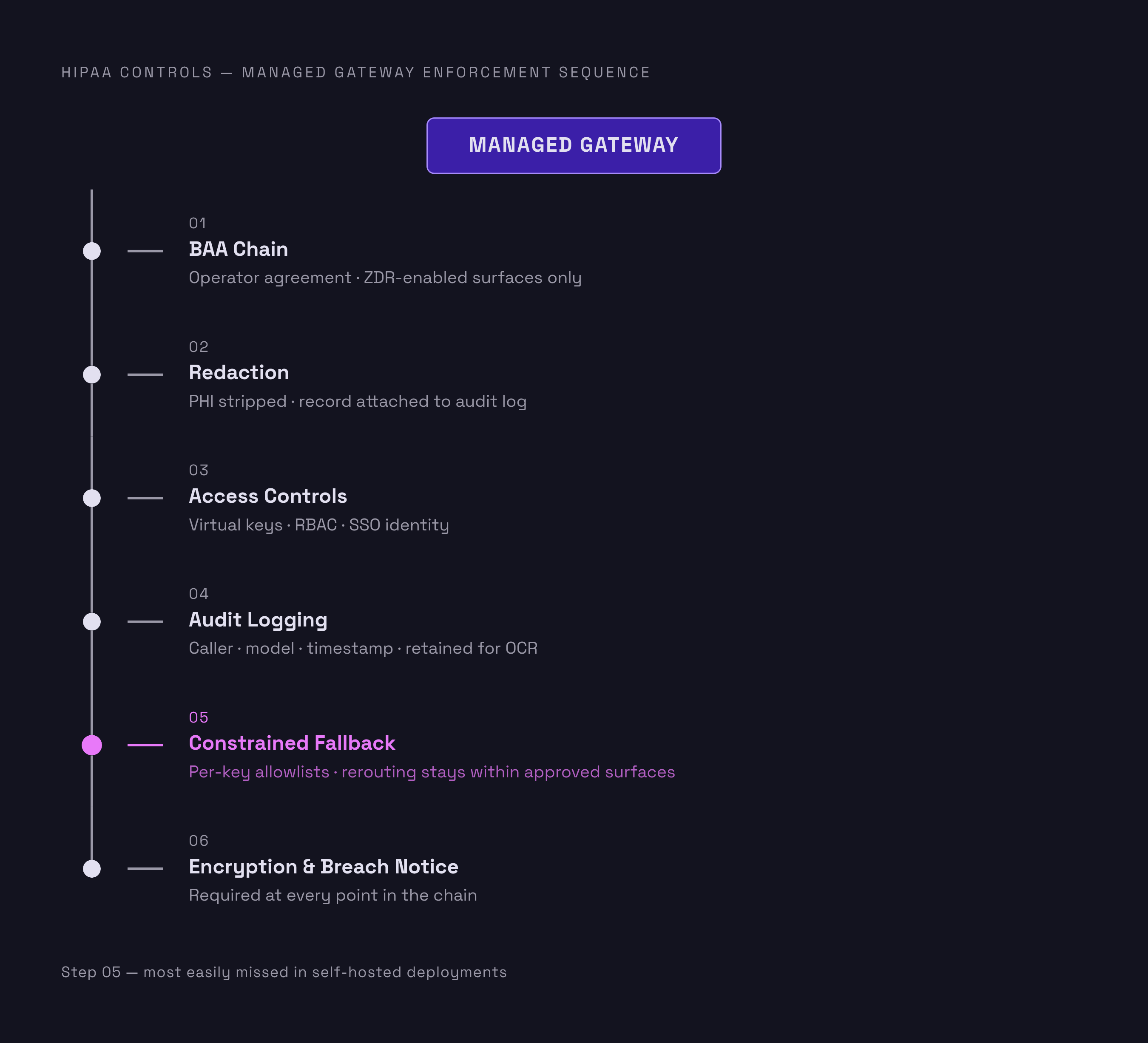
A gateway creates a common enforcement point only when every PHI-touching request passes through it. The first step is the BAA chain. The operator signs an agreement covering the gateway itself and restricts regulated traffic to provider surfaces that are BAA-covered and ZDR-enabled. Encryption and breach notification are required at every point in that chain. Centralizing routing provides a place to administer these obligations, but does not replace the underlying technical and contractual commitments.
The second step is redaction before prompts reach providers. Policy at the gateway strips sensitive data and attaches a redaction record to the request’s audit log. Access controls form the third step. Scoped virtual keys separate teams, projects, and integrations, while RBAC limits access to PHI-touching models and SSO connects activity to an auditable user identity. These controls no longer depend on each application implementing equivalent safeguards.
Audit logging is the fourth enforcement step. Each PHI-touching request records caller identity, model, provider, timestamp, and the redaction record, with retention maintained centrally for OCR investigations. The fifth step constrains fallback routing through per-key provider allowlists. An outage can then change the destination only within the approved set of covered surfaces.
Is a fully managed gateway an alternative to running LiteLLM for PHI workloads?
A fully managed gateway provides the routing layer without requiring the customer to deploy or operate a proxy. Self-hosted tools such as LiteLLM remain legitimate options, but hosting transfers uptime, patching, credential rotation, and model catalog maintenance to the team running them. That responsibility persists after initial integration. For PHI workloads, an operational gap can also expose a gap in compliance enforcement.
A single proxy instance can become a point of failure, while a stale catalog can lag behind changes to provider surfaces. Retry policies create another operational hazard. A proxy retry layered over SDK and provider retries can compound cost and latency during partial outages. More seriously, an application that bypasses an unavailable proxy may send PHI outside its intended BAA-covered path.
With a managed service, the vendor takes on those operating tasks. There is no customer instance to patch or scale, no model catalog to maintain, and no proxy retry policy to tune. The application team still configures its permitted routes and policies. The distinction is between configuring a service and sustaining the infrastructure that enforces those settings while the team also ships product.
What to look for when evaluating a managed BAA gateway for PHI workloads
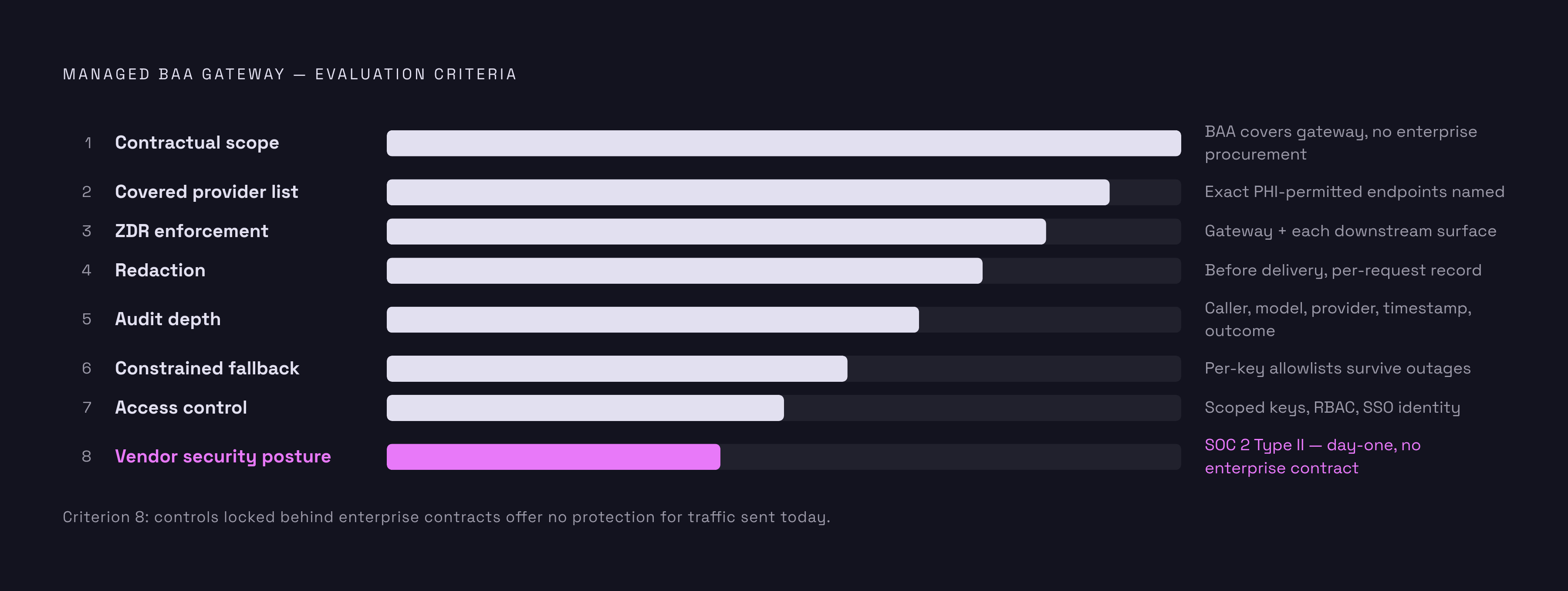
The buyer’s checklist begins with contractual scope: whether a BAA covers the gateway service itself and is available without enterprise procurement. The second is the covered provider list, including the exact endpoints permitted to receive PHI and enforcement that excludes other surfaces. Both need explicit answers before deployment. A provider’s agreement alone does not establish coverage for the intermediary handling the request.
The third criterion is ZDR enforcement at the gateway and each downstream surface. The fourth is redaction before provider delivery, with a reviewable record attached to each request. The fifth is audit depth. A general claim that the platform “has logs” does not establish whether logs include caller identity, model, provider, timestamp, and redaction outcome, together with retention sufficient for an OCR investigation.
The sixth criterion is constrained fallback, with per-key allowlists that preserve BAA coverage during outages. The seventh is access control through scoped virtual keys, RBAC for PHI-touching models, and SSO-backed identity. The eighth is the vendor’s security posture. That review covers SOC 2 Type II certification, audit retention, and whether small teams can get the controls they need from day one. Features that come only with a later enterprise contract do not protect traffic sent today.
How a managed, zero-infrastructure BAA gateway meets the criteria
Concentrate AI is one fully managed option that offers a BAA on its BAA subscription tier for HIPAA organizations, with no proxy to deploy or maintain. It combines gateway-level PHI and PII redaction, zero data retention, audit logging, RBAC, and SSO, making the compliance boundary available without an enterprise procurement process.
Against the first two criteria, the service provides a gateway BAA and enforces a defined set of covered provider surfaces for PHI traffic. Its broader catalog spans models from dozens of providers, but that catalog is not the regulated routing permission set. ZDR addresses the third criterion, while policy-enforced redaction before provider delivery addresses the fourth and leaves a reviewable per-request record.
Audit logging and records of routing decisions help meet the fifth criterion. Per-key provider allowlists satisfy the sixth by constraining fallback to covered surfaces rather than allowing an outage to open an unrestricted route. RBAC, SSO, and scoped keys address the seventh. SOC 2 Type II certification and day-one access to security controls address the eighth, including for a five-person team without an enterprise contract. Required audit retention still belongs in the buyer’s scope review.
The operational commitment is equally concrete. There is no customer instance to deploy, patch, or scale, and spend is visible by team, project, key, model, and provider. The stated billing model has no token markup, platform fee, card fee, or BYOK fee, with customers paying for tokens. Those commitments connect the compliance framework to the original operating problem without implying that every available model is appropriate for PHI.
How to route OpenAI, Anthropic, and other providers through the gateway without touching application code
For an application already using an OpenAI-compatible SDK, the integration path is a base URL change and a virtual key. The SDK points to the gateway instead of a provider endpoint, and the gateway translates the request for the selected provider and model. The application’s request logic stays in place. “No application code changes” describes this compatible-client path, rather than a claim about every existing provider-specific integration.
For a PHI workload, configuration establishes the boundary. The virtual key has its own budget limit, rate limits, model allowlist, and PHI-handling policy, while provider credentials remain outside application code. Its provider allowlist is restricted to BAA-covered surfaces. Redaction runs before data reaches the provider, and the audit log records access along with the key’s identity.
Fallback chains are configured at the gateway as well. If the primary model goes down, routing moves to the next allowed provider without fallback logic in the application, while regulated keys stay within their covered allowlists. Each request also contributes to real-time spend totals by team, project, key, model, and provider. Finance and security can see the same data as engineering. Neither group needs access to application logs to reconstruct that usage.
Deciding when a managed BAA gateway is the right call versus a self-hosted or hybrid approach
A managed gateway fits teams that handle PHI and have no dedicated platform team or cannot let gaps in proxy maintenance become gaps in compliance. It also fits teams that need BAA coverage quickly and need people outside engineering to see spend and audit data. The choice depends on the capacity to keep a gateway’s controls available during maintenance, provider changes, and outages.
Self-hosting can fit an experienced platform team that already runs similar infrastructure, especially when data residency rules require traffic to stay within a specific network perimeter. Workloads without PHI may also lack the same compliance driver. Residency needs deserve a precise comparison. The managed service described here defaults to US regions but offers region-specific hosting through an Order Form or DPA, so geography alone does not settle the architecture.
A hybrid approach keeps a self-hosted proxy as the primary path and a managed gateway as a warm, configured fallback. That makes the team less dependent on the primary proxy, but it must check BAA coverage and PHI routing constraints for both paths. The fallback cannot be a compliance exception. Its policies must be ready before an outage forces traffic onto it.
For an AI-native healthcare startup, the practical constraint is often the capacity to operate infrastructure while shipping the product. Fast-growing teams in fintech, insurtech, legal, and insurance face a similar decision where PHI or PII handling is in scope. A BAA from day one, security controls, and a service run by the vendor help teams that lack that capacity. A small team can configure its compliance boundary without also taking responsibility for the proxy that must enforce it.
How to cite
Priya Nandakumar. Routing OpenAI Anthropic and Other Providers Through a BAA-Backed Gateway With No Infrastructure to Provision. HIPAA Model Index. November 24, 2026. hipaamodelindex.com/posts/routing-openai-anthropic-and-other-providers-through-a-baa-backed-gateway-with-n
© 2026 HIPAA Model Index